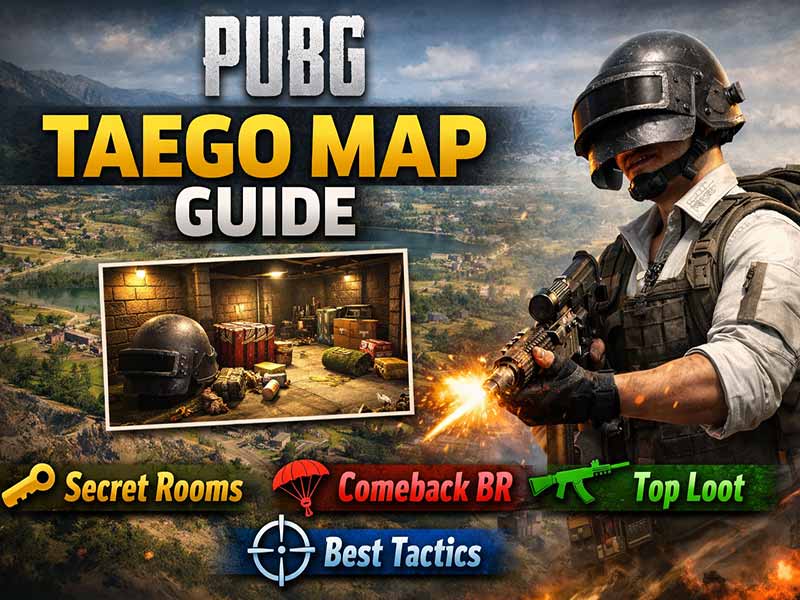
PUBG Taego is an 8×8 Korean battleground map that rewards smart drops and rotations, featuring Comeback BR second chances plus Secret Rooms for upgrades.
Taego has become popular among players who favor a stronger tactical pace without sacrificing the close-quarters combat firefights. The map separators not only feature open rice fields, rolling slopes, and steep ridgelines, but also densely populated townships and significant landmarks. Therefore, players have to decide whether to play it safe or fight for position early on.
Unlike maps where the “best” plan is always to hot-drop or always to hard-rotate, Taego gives you more viable paths to victory: you can win by holding high ground, by timing rotations through cover, or by taking calculated risks and recovering when things go wrong.
Taego at a Glance
- Map size: 8×8 km
- Theme: South Korea-inspired terrain—farmland, mountains, villages, and industrial zones
- Match feel: Rotations matter more than raw aggression; terrain control is often the difference-maker
What Taego Looks Like in Real Matches
Taego’s terrain creates two constant pressures:
Open-field punishment:
Rice paddies and farmland look “safe” until you’re caught crossing with no hard cover. If you rotate late, you’ll often be forced into long sprints that get punished by teams holding ridges.
Compound warfare:
Many towns and landmark areas have layered angles—windows, rooftops, walls, and narrow lanes. Fights can end quickly, but third parties arrive fast too, especially near central routes.
The result is a map where timing is everything. Early rotation allows you to secure a favorable position; late rotation means you’re going against the wind.
Taego’s Signature Mechanics
Comeback BR / Comeback Arena (second chances)
Taego’s identity is tied to its comeback system. Depending on the current ruleset, players eliminated in the early phase can get a chance to return later—so early deaths don’t always mean the match is over.
How does it change your decisions?
- Early fights are still worth taking, but don’t throw your game chasing one knock.
- Midgame rotations can feel “crowded” because returns add pressure to common routes.
- If you’re a team, survival and coordination often beat highlight-reel pushes.
Self-AED (Solo-focused in recent rulesets)
In newer rulesets, Self-AED has been treated as a Solo-focused mechanic and removed from team modes. The practical takeaway is simple:
In Solo, don’t assume a knock is done.
Clear angles, listen, and confirm your finish before looting.
Environmental Cues and Small Details
Taego rewards awareness. Even without “hard” intel tools, you can read the map:
- Bird movement: If birds suddenly scatter along a quiet edge, treat it as a warning that someone’s moving through.
- Sound travel: Hills and valleys can distort distance—use repeat sounds (shots, vehicles) to triangulate direction rather than guessing range.
- These details won’t win the game alone, but they regularly save you from walking into the wrong fight.
Key Areas and How to Use Them
Instead of memorizing “best POIs,” think in terms of how a place plays:
Terminal (high traffic, high reset pressure)
Terminal tends to produce fast fights and constant third parties. Great if your squad is confident at quick clears and fast resets; risky if you need time to loot.
Buk San Sa (high ground, surrounding risk)
A strong tactical location with visibility and hold potential—but if you stay too long without a rotation plan, you can get boxed in by teams wrapping the hills.
Ho San Prison (tight angles, chaotic pushes)
A landmark-style area that forces close-range decision-making: who holds the strongest angles, who controls entries, and who gets trapped inside.
Edge villages and small compounds (consistency route)
If you want steady top-10s or you’re new to Taego, quiet edge drops let you gear safely and rotate with less pressure—especially if you move before the midgame traffic builds.
Secret Rooms and Keys
Secret Rooms are one of Taego’s most valuable loot routes because they can spike your gear quickly—if you play them cleanly.
How to approach Secret Rooms without throwing your match
- Treat keys as opportunistic: if you find one, route to a room; don’t build your whole game around “forcing” a key.
- Open, loot, and leave fast—Secret Rooms attract campers and late third parties.
- Don’t tunnel vision on one room if the circle is pulling away. Position still wins games.
Anti-camp habit that works:
Before you open a room, clear nearby sightlines, listen for footsteps, and assume someone heard you arrive.
Vehicles and Mobility
Taego’s road network makes vehicles powerful for tempo—especially when you want to beat other teams to a ridge or move around a hot midgame choke.
Two Taego-flavored vehicles you’ll see often
- Porter (pickup): Great utility vehicle—durable, stable, and useful as a temporary cover.
- Pony Coupe (retro sedan): Strong rotation vehicle for fast road moves and early zone positioning.
Vehicle tips that win games
- Rotate early with a vehicle, then dismount before the final approach so you don’t broadcast your entry.
- In late circles, cars can be covered—but only if you park with a clean escape route.
- Avoid committing to bad terrain (deep paddies, steep slopes). Getting stuck is a quick death on Taego.
How to Play Taego by Skill Level
Beginners
- Drop safer → loot calmly → rotate early → avoid long open crossings.
- Play the edge of the zone with cover and don’t chase shots across paddies.
Advanced players
- Win Taego by controlling ridges and reverse slopes.
- Take fights that give you position, not fights that pull you into low ground.
Squads
- Assign roles (scout/entry/support) so fights don’t become four people doing the same thing.
- Save utility (smokes) for rotations and revives—Taego punishes exposed movement hard.
FAQ
Q: Is Taego good for ranked-style play?
Yes—it’s rotations, ridge control, and structured compounds reward disciplined teams more than pure hot-drop RNG.
Q: Are Secret Rooms worth it?
They can be, but only if you treat them as “quick upgrade routes,” not as a reason to ignore the circle or overstay in one area.
Q: What’s the biggest mistake on Taego?
Rotating late and getting forced into open ground. If you consistently move earlier, you’ll feel the map become much easier.
Summary
Taego is special because it keeps you making real decisions: fight now or rotate, chase upgrades or take position, play slow or pressure lanes. If you learn the terrain and respect timing, the map becomes less random and more controllable—and that’s why people keep dropping into Taego season after season.